

Brilliant News
Publish Time:2025-12-26
On November 28, 2025, the third 2025 "AI+" Innovation Technology and Application Online Live Sharing Session was successfully held. The event was organized by the Low-Altitude Economy Spatiotemporal Information Application Working Committee of the China Association for Geographic Information Society and hosted by Beijing BrilliantTechnologies . (hereinafter referred to as "Boneng").
This live broadcast seized the historic opportunity presented by artificial intelligence being included as a core element in the "15th Five-Year Plan" for the first time. It focused on how the low-altitude economy can leverage AI to achieve a high-quality leap forward. The session invited two frontline industry experts: Mr. Fang Ming, Senior Advisor for Low-Altitude Business at Beijing Boneng Technology Co., Ltd., and Mr. Dong Zhijun, Industry Technology Director of the Changsha Planning Information Service Center. Centered on three core topics—policy interpretation, ecosystem construction, and technology integration—they delivered a high-density, high-value intellectual feast for the audience.
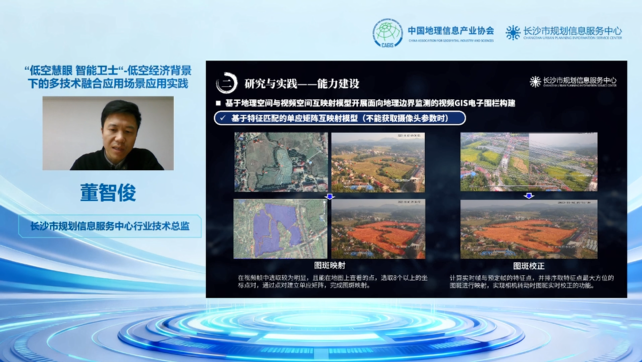
Drawing from their extensive practical experience serving numerous clients and solid policy research, Mr. Fang Ming and Mr. Dong Zhijun delivered keynote speeches titled "The Whole-Region Collaborative Management System for the Low-Altitude Economy" and "'Low-Altitude Insight, Intelligent Guardian'—Application Practices of Multi-Technology Integration Scenarios in the Context of the Low-Altitude Economy", respectively.
1. AI + Digital Twin: Building a New Paradigm of "Full-Space, Full-Airspace, Full-Scenario" Intelligent Management and Control
Mr. Fang Ming, Senior Advisor for Low-Altitude Business at BrilliantTechnologies , pointed out that the current development of the low-altitude economy is facing a critical policy window. The technical concept of "Digital Twin + AI" has not been fully applied in the low-altitude domain. The existing situation where military/civil aviation and urban low-altitude development operate in separate silos is increasingly inadequate to meet the demands for large-scale, high-frequency, and multi-entity low-altitude flights. There is an urgent need to promote data interoperability and dynamic, flexible airspace allocation.

Boneng's created Whole-Region Low-Altitude Collaborative Management and Control Platform employs a systematic approach of "full-space support, full-airspace control, and full-scenario assistance" to solve collaborative challenges. It supports regions in developing comprehensive low-altitude economy management and control capabilities, providing integrated flight management services. This platform offers a solid technical foundation and implementation pathway for the large-scale, safe, and intelligent development of the low-altitude economy.
2. Local Practices in the Low-Altitude Economy: Innovative Pathways Empower Urban Governance with Digital-Intelligent Leap
Mr. Dong Zhijun, Industry Technology Director of the Changsha Planning Information Service Center, shared Changsha's experience in building a low-altitude economy ecosystem from the perspective of local practice. Against the backdrop of accelerating low-altitude economic development, Changsha's construction is based on a "3+1+1" overall architecture (three networks, one foundational platform, one service platform). This provides valuable insights for exploring comprehensive intelligent management and control of low-altitude flights and the construction of all-time, all-airspace, all-element, and fully-connected low-altitude services. Utilizing core technologies centered on "low-altitude video IoT + GIS + AI," significant results have been achieved in the application and promotion of digital-intelligent scenarios such as illegal construction monitoring, construction project progress tracking, cultivated land protection supervision, and environmental water quality monitoring. These efforts contribute to the upgrade of Changsha's smart city governance capabilities and offer a reference case for local low-altitude economy practices nationwide.
Currently, artificial intelligence is accelerating the deep integration of technologies such as geographic information, digital twins, and cloud computing, driving the spatial information industry from "data collection" comprehensively towards a new stage of "intelligent decision-making." In the future, with continuous technological innovation, expanding application scenarios, and gradual ecosystem improvement, the low-altitude economy will no longer be a "niche industry in the sky." Instead, it will become a "new engine" integrated into urban development, serving public needs, and driving economic growth.
As the organizer, the Low-Altitude Economy Spatiotemporal Information Application Working Committee of the China Association for Geographic Information Society will continue to deepen the construction of the "AI + Spatial Intelligence" ecological platform. It aims to consolidate the strength of industry, academia, and research to promote the deep integration of the low-altitude economy with spatiotemporal information and the practical application of AI within the low-altitude economy industry, thereby empowering high-quality industrial development.


Telephone Counseling
Company Address:Room 101, 17th Floor, Block A, Xueqing Jiachuang Building, No. 10 Xueqing Road, Haidian District, Beijing.
Contact Number:010-82608581
HR Email:zhaopin@bjbn.net